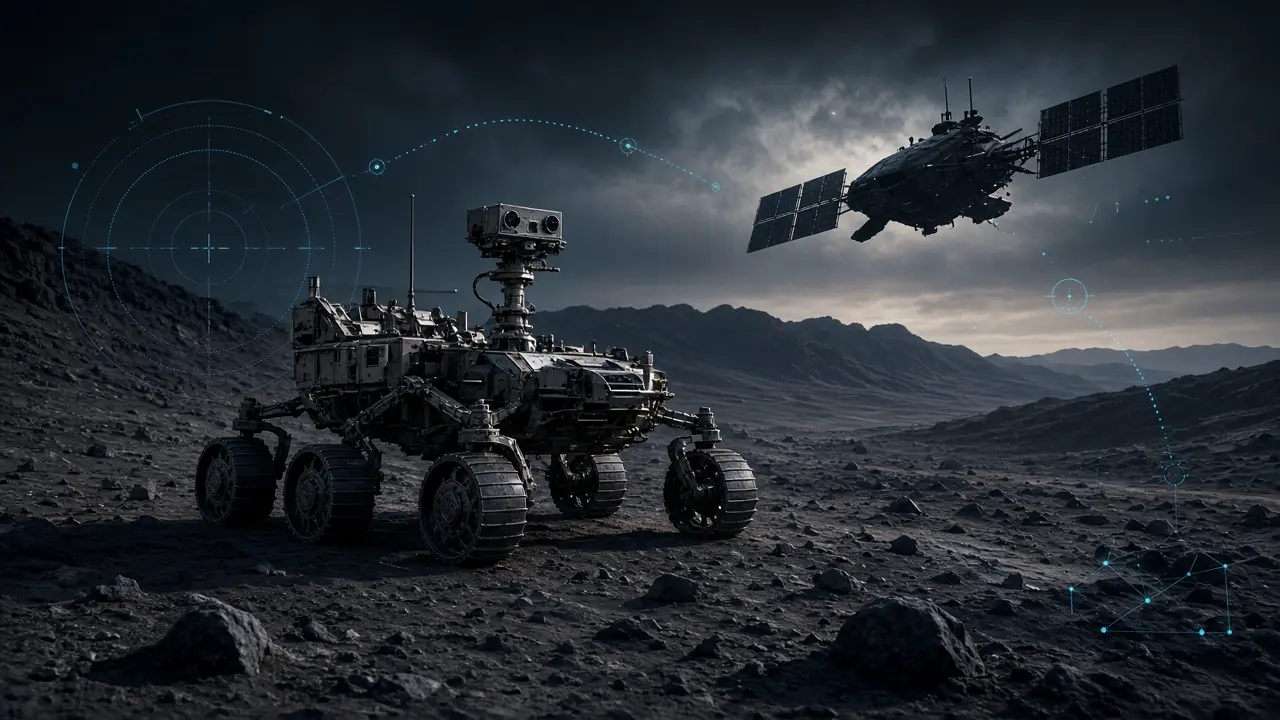
NASA Robots Are Making Science Calls Without Waiting on Earth
ASTRA field tests: weigh the science payoff against the risk in real time. Outer-planet missions need judgment, not just scripts.
Space exploration has a timing problem that no faster rocket fixes: light-speed delay. By the time a human on Earth says “go sample that rock,” the opportunity may already be gone — or the hazard already closer. NASA’s ASTRA team just published a field-test write-up that treats that constraint as the design brief.
So basically: the next leap for planetary science is not a smarter single rover. It’s a small fleet that can act like a junior science team when Earth is too far away to micromanage.
What they tested
This summer at the Virginia Tech Transportation Institute in Blacksburg, a three-robot setup — a scouting drone and two ground vehicles — practiced behaving like an independent science crew. Humans set initial goals. Then the fleet’s software weighed risks against science payoff and assigned the right robot to investigate.
As work progressed, the system kept checking hazards, revising plans, and reporting back to NASA’s Adaptive Sensing Technology for Responsive Autonomy (ASTRA) managers. When the lead drone spotted an extra area of interest, it didn’t ditch the original task. It paused, processed the opportunity, and pulled in another asset to look — the kind of triage a field geologist does without thinking.
One rover mapped with lidar. Another collected samples with an arm. The drone scouted from above. Boring division of labor. That’s the point.
Subjective criteria are the hard part
Anyone can code “drive to waypoint B.” ASTRA is chasing something messier: decisions that mix objective facts with human priorities. How far is each robot? How fast can it move? How badly does the science team want this sample versus that map? Is the risk acceptable?
”We want to find a way for missions to do things that they could never do before because they didn’t have a decision-maker on board that can weigh all these criteria at the same time,” said Bethany Theiling, ASTRA principal investigator at Goddard, in NASA’s write-up.
Success, in their framing, means the fleet can act correctly without direct instructions — based on its physical limits and the team’s stated risk appetite. That’s alignment for science ops, not for chatbots.
Why it matters for near-future space
Outer-planet flybys, shadowed lunar pits, and high-risk Mars terrain all share the same constraint: humans can’t drive every choice in real time. Teleop works for LEO and some lunar work. It falls apart when the round trip is measured in hours.
This is also distinct from “space infrastructure” stories about ground stations and debris policy. Those decide who compounds. Fleet autonomy decides what science you can still do when the link is thin.
The grounded take
Don’t confuse a Virginia test track with a Europa lander. Do notice the product shape: multi-agent triage, explicit risk budgets, and humans still in the loop as managers rather than joystick jockeys.
When NASA (and partners like Noblis on this campaign) can show fleets that keep original goals and opportunistically expand them without getting lost in rabbit holes, outer-solar-system science gets a new lever. Until then, treat ASTRA as a progress report on judgment under delay — the unglamorous capability launch cadence never buys you.
So basically — pass it on.