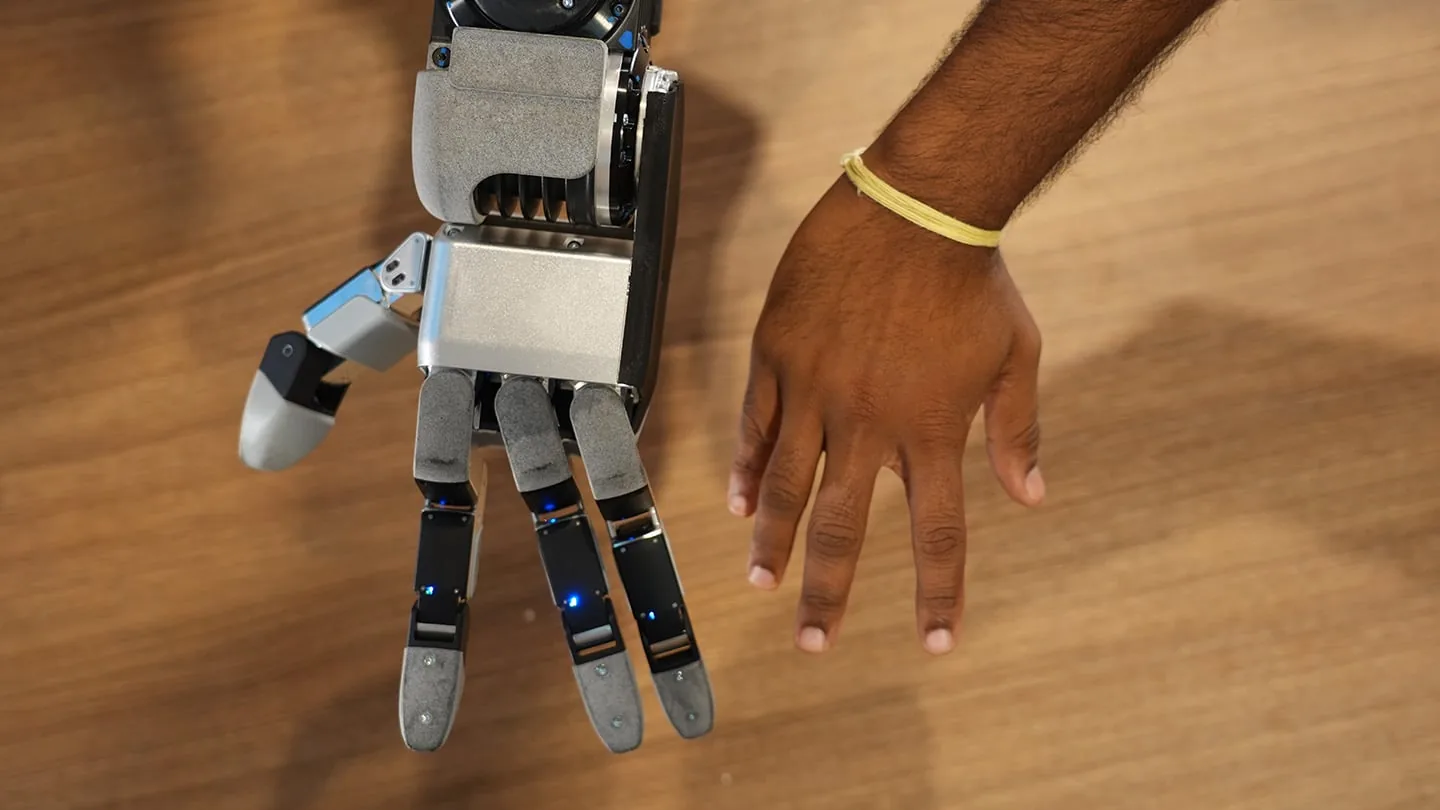
Boston Dynamics Posted a New Atlas Hand With Four Fingers
The Oct. 1 write-up drops the pinky. The new hand has 13 degrees of freedom, direct drive, and a job list that starts with tools.
So basically: Boston Dynamics posted a new hand for Atlas on Oct. 1. It has four fingers and 13 degrees of freedom. They left the pinky off on purpose.
What changed
The last Atlas hands had seven degrees of freedom and were built to grab a lot of different objects. This one is built to move those objects around.
The thumb has four degrees of freedom. Each of the other three fingers has three. That is the 13. Every joint uses the same kind of actuator, driven directly, with no cables running across the joints. Boston Dynamics says the actuators are sealed the same way as the ones in the body.
The hand is about the size of a large human hand, because Atlas has to reach into spaces built for people. Boston Dynamics says it kept about the same strength as the older hand, enough to carry a loaded mini fridge that weighs more than 100 pounds. That figure is theirs.
The fingertips and the palm have pressure sensors. The company also says the joints are backdrivable, so a hit can move the finger instead of breaking the gearbox.
No pinky
Boston Dynamics says adding a fifth finger would have been easy. It would also add three more actuators, more cost, more size, and more parts that can fail.
Their CTO, Zack, had the team tape a pinky to the next finger for a day and report what they could not do. After that, they agreed to ship four fingers.
What they say it can do
The post lists four behaviors:
- Slide the thumb tip along the length and across the width of the other fingers
- Pinch between the thumb and any other finger
- Hold with three contact points and still move the object
- Grab a tool and press its trigger, including drills, torque drivers, grinders, nail guns, and welding torches
They also say early tests trained in simulation have transferred to the real hand, using joint sensing only, with no extra camera loop in that test. Those are lab results, not a factory shift.
My take
The Georgia training center was last week’s story. This is the part that has to work once a robot is standing at a bench. Four fingers is a manufacturing choice, not a costume. The open question is still whether those trigger grasps hold up on a line, not whether the demo video looks like a hand.
So basically — pass it on.