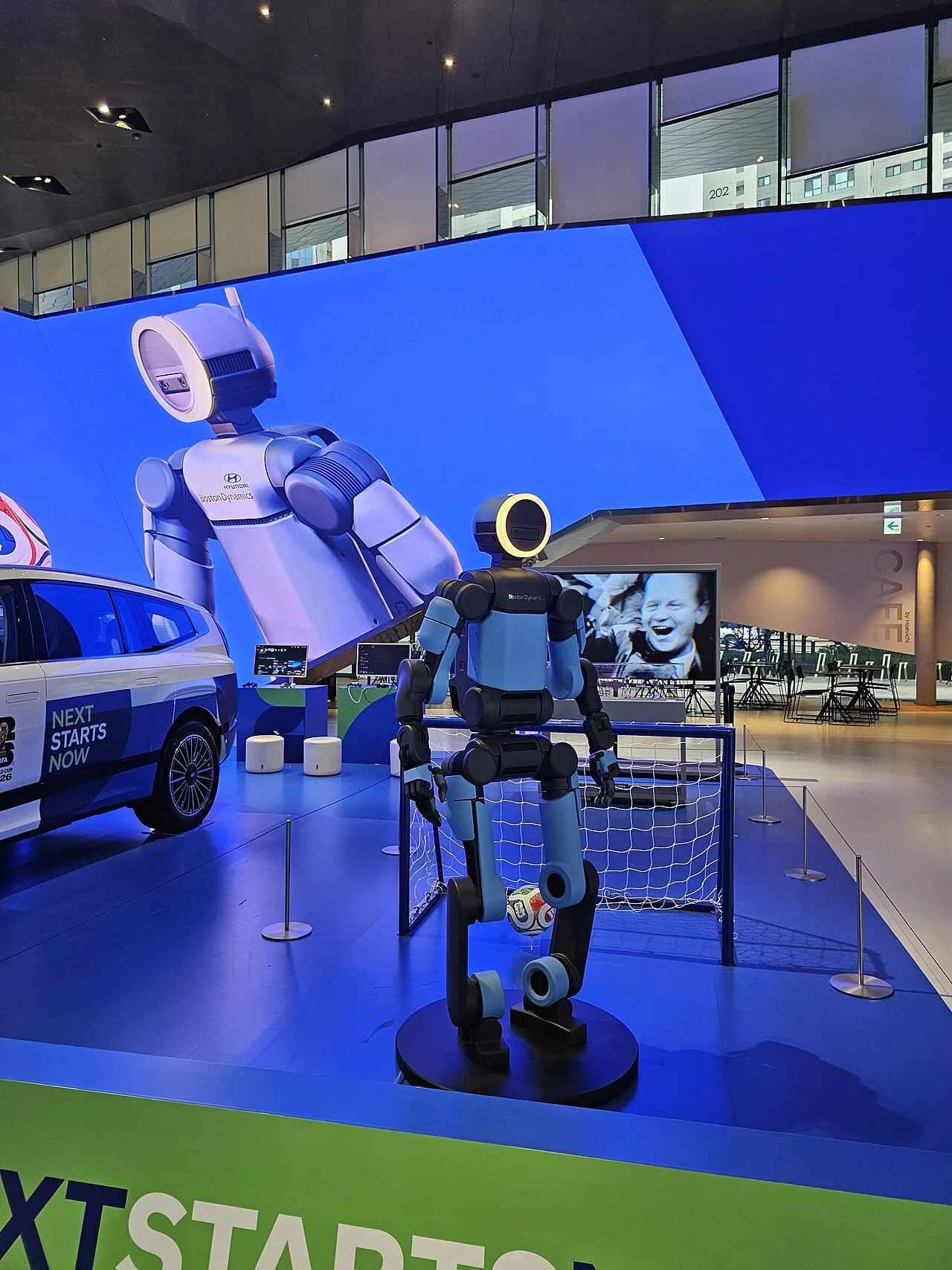
Boston Dynamics Opens Georgia Center to Train Atlas for Factory Work
The new RMAC center inside Hyundai’s Georgia Metaplant will train Atlas humanoids on real automotive workflows. It is an operational testbed, not evidence that Hyundai has deployed 25,000 robots.
Boston Dynamics opened the first phase of its Robotics Metaplant Application Center, or RMAC, on Sept. 21, 2026, inside Hyundai Motor Group Metaplant America near Savannah, Georgia. The center will train Atlas humanoid robots on real automotive work before wider factory deployment.
The distinction matters. RMAC is a testbed and behavior-training facility. It is not evidence that Hyundai has already put tens of thousands of Atlas robots to work.
So basically: Boston Dynamics now has a permanent site inside an operating auto campus where it can collect data, test applications, and prepare Atlas for specific manufacturing tasks. The large deployment and production figures attached to the announcement remain company targets.
Atlas starts with parts logistics
Boston Dynamics says Atlas robots at RMAC are initially learning logistics work: preparing automotive parts, sequencing them in the correct order, and placing them for assembly. The company plans to extend the work to component assembly by 2030.
These tasks require more than moving a standard box between fixed points. Zack Jackowski, Boston Dynamics’ chief product and technology officer, told The Robot Report that automotive parts can have fragile or cosmetic surfaces, restricted gripping areas, awkward weight distribution, and packaging that requires two-handed manipulation. Parts may need to be extracted from shipping containers and inserted into tightly packed carts for delivery to the assembly line.
Boston Dynamics said Atlas could eventually take on repetitive and physically demanding jobs, including lifting heavy loads. That is a future application plan, not a description of broad deployment today.
A center for data and behavior training
The Robot Report described RMAC as a permanent facility for data collection and application testing, working closely with the Hyundai plant. Jackowski called it a “Robot Behavior Factory”: real parts, fixtures, work cells, Atlas robots, and trained operators producing data that can be used to improve robot behavior.
According to The Robot Report, Boston Dynamics is combining several training methods. These include teleoperation, reinforcement learning in simulation, and Universal Manipulation Interface devices that capture human demonstrations. The company is also studying how packaging, fixtures, and factory support processes may need to change to make humanoid deployment reliable.
That makes RMAC different from a showroom demonstration. It places development next to real automotive workflows and gives engineers a controlled location to find the practical problems that appear when a robot handles production parts repeatedly.
It is still a development step. A dedicated training site can produce better data and more reliable behaviors, but it does not by itself establish production-level uptime, economics, safety, or demand.
A much larger site is planned for 2027
The first phase is now operational inside the Hyundai campus. Boston Dynamics says operations will move in 2027 to a new building at the Metaplant that is approximately 10 times the size of the current site.
The larger center will continue preparing Atlas for automotive deployment. Boston Dynamics also plans to explore applications in other industries, including aerospace, semiconductors, logistics, food and beverage, and life sciences. The company says it is discussing future data-collection work with existing customers of its Spot and Stretch robots.
The Robot Report also reported that Boston Dynamics has moved some employees from its Waltham, Massachusetts, headquarters to Savannah and is hiring for additional roles. That adds operational detail to the company’s expansion plan, but Boston Dynamics has not disclosed how many Atlas robots are currently training at RMAC.
The deployment targets are not current fleet counts
Hyundai says it plans to deploy 25,000 Atlas units across Hyundai Motor and Kia plants around the world over the next few years. The group also says it will establish a U.S. facility capable of producing 30,000 robots per year. The Robot Report says Hyundai is targeting 2028 for that factory capacity.
Those numbers describe corporate plans. They do not mean 25,000 Atlas robots are operating today, and annual factory capacity is not the same as annual production or customer deliveries.
The announcement does provide a more concrete path toward those targets. Boston Dynamics has placed an operational training center inside a Hyundai manufacturing campus, started with defined parts-logistics tasks, set a 2030 goal for component assembly, and committed to a substantially larger facility next year.
RMAC’s near-term value will be measured by what Atlas can learn and repeat safely in those workflows. Evidence of scaled deployment will require separate disclosures about fleet size, uptime, completed tasks, human intervention, and use across Hyundai and Kia plants.
So basically — pass it on.