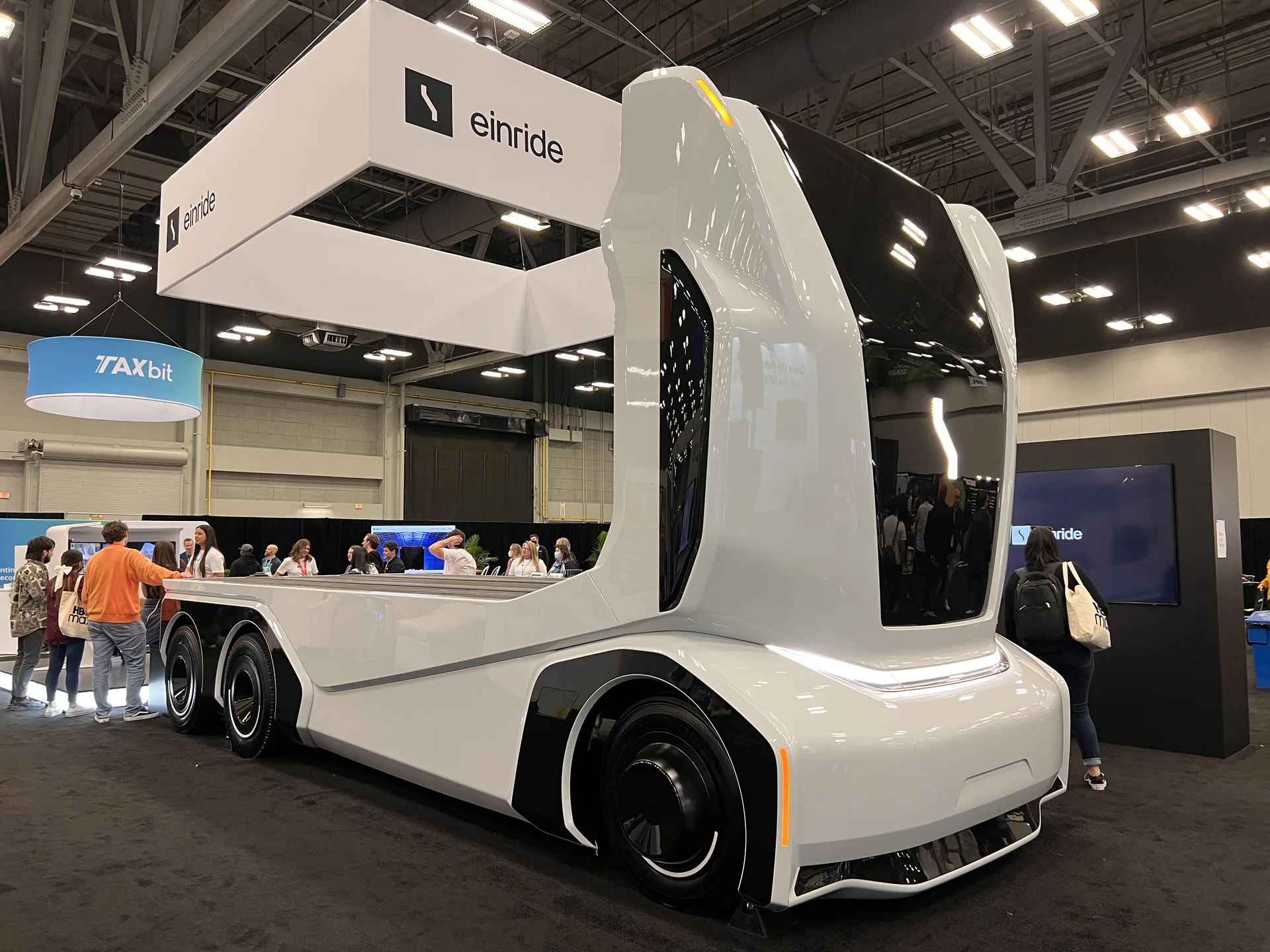
Einride’s Cab-Less Truck Is Hauling Lidl Freight on a German Public Road
Germany’s KBA cleared an SAE Level 4 cab-less electric truck for daily Lidl store runs in Edermünde — no driver in the cab, remote backup, mid-September start.
Most autonomy demos still keep a human in the seat “just in case.” Mid-September in Edermünde, Hesse, Lidl and Swedish freight tech company Einride put a truck on a public road with no cab, no steering wheel, and nobody on board — under a German federal permit, not a parking-lot waiver.
So basically: Germany’s Federal Motor Transport Authority (KBA) cleared an SAE Level 4 cab-less electric truck for regular Lidl distribution-to-store runs, with remote operators as backup and a narrowly scoped route that makes the safety case possible.
What is actually running
Einride and Lidl announced the start of daily operations on Sept. 15, 2026. The vehicle is Einride’s cab-less electric freighter (described in trade coverage as the eBot), sized for about 15 Euro pallets. It moves dry goods between Lidl’s Edermünde warehouse/distribution site and a nearby store on a short public-road link — roughly 400 meters each way, up to three trips a day, with more than 3,000 pallets planned across a roughly four-month pilot.
Pilot speed is capped at 25 km/h. That is not highway autonomy. It is a deliberately boring logistics loop: same corridor, low speed, repeated schedule. The companies say a multi-stop “milkrun” expansion is on the table for 2027 if the pilot holds up.
The permit is the story
Germany’s 2021 Autonomous Driving Act already allowed Level 4 on public roads inside a defined operating area. What is new here is the first-of-its-kind KBA authorization for a cab-less Level 4 truck in this kind of daily retail logistics use — Reuters and Einride both frame it that way. Trade reporting that cites the KBA trial-approval list puts the permit effective Aug. 14, 2026, currently through Feb. 28, 2027.
Safety is layered: geofenced ODD, low speed, redundant systems, and Einride teleoperation over 5G so a remote pod operator can supervise (and, if needed, intervene on) steering, throttle, and brakes. Trade coverage also notes a KBA requirement for a manned support vehicle to follow during the pilot — remote backup does not mean “no humans in the system.”
Progress and limits
Progress: Europe’s largest road-freight market just let a driverless, cab-less EV into a real Lidl replenishment loop under federal paperwork, not a closed campus. Limits: short route, slow speed, time-boxed permit, support chase vehicle, and no claim yet that this scales to long-haul or city-wide freighter fleets. Loading docks still need humans. Driver shortages do not vanish because one 400-meter shuttle works.
Watch the KBA window, whether the milkrun opens in 2027, and whether Schwarz Group sites beyond this one store adopt the same pattern. The headline is regulatory proof on asphalt — not a nationwide robot trucking network overnight.
So basically — pass it on.