HS2 Just Joined Up Its Mile-Long Wendover Green Tunnel
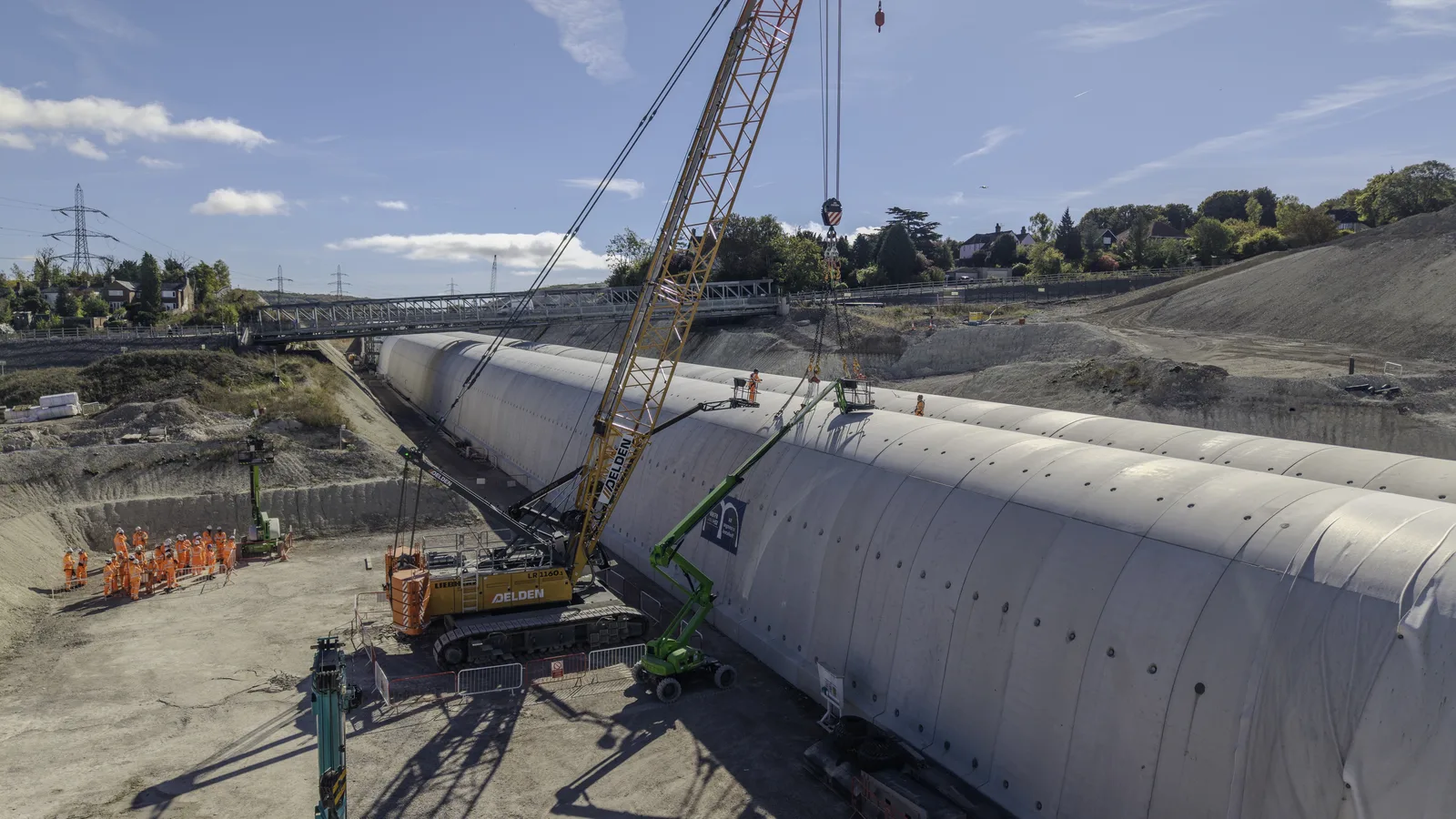
On Oct. 5, crews lifted the last of 2,740 precast concrete segments into place on HS2's Wendover green tunnel in Buckinghamshire, linking the two halves for the first time. Next comes backfill, a road over the top, and landscaping.
So basically: Britain’s HS2 high speed railway just finished the main structure of a mile-long tunnel built in a trench and then buried. On Monday, Oct. 5, crews placed the last segment of the Wendover green tunnel in Buckinghamshire. That joined the two halves for the first time.
What a green tunnel is
Most tunnels are bored through rock. This one is different.
A green tunnel is built in a big open trench. Crews put a concrete tube in the trench, then pile the earth back on top. Grass and trees go on the roof. From the surface, it is supposed to look like countryside again.
The point is to hide the railway, so nearby homes hear and see a lot less of it.
What happened this week
The Wendover green tunnel is about 1.4 km long. That is roughly a mile. It runs beside the A413, just west of Wendover.
It is made from 2,740 precast concrete pieces. They come in an “M” shape, so the finished tunnel has two side by side bores, one for northbound trains and one for southbound.
To go faster, it was built as two sections at the same time. Those two halves met this week.
The first segment went in during spring 2025. The contractor says more than 2,000 segments were lifted in under 18 months.
The final piece went in on Oct. 5. The team signed their names on it before it was lifted.
Most segments were lifted by crane. But some had to go under a temporary bridge that carries Ellesborough Road over the site. For those, the team used a self-propelled modular transporter, a low machine with 16 sets of wheels. It lifted the pieces from underneath and set them in place beneath the bridge.
How big a dig this was
To make room for the tunnel, crews dug out more than 1.2 million cubic meters of earth. Most of it was chalk.
That material was stored on site. Now it is being put back and packed down over the tunnel, so the weight spreads evenly across the structure.
What comes next
The central structure is done, but the tunnel is not.
Next up, according to HS2:
- Building the portals at each end
- Finishing the floor slab
- Fitting out the inside
- Backfilling over the top
- Realigning Ellesborough Road so it runs over the tunnel
- Landscaping
What the builders said
Umesh Gorasia, a project manager at HS2 Ltd, said:
“It’s great to see the two halves of the tunnel linked up for the first time. Once complete, the green tunnel will dramatically reduce disruption from passing trains and blend the railway into the countryside.”
The tunnel is being built by EKFB. That is a joint venture of Eiffage, Kier, Ferrovial Construction, and BAM Nuttall.
The bigger picture
Wendover is one of five green tunnels on the route. The others are at Copthall, Chipping Warden, Greatworth, and Burton Green. Copthall was finished this summer. EKFB is building three of the five.
Overall, about 65 miles of tunnels will be built between London and the West Midlands. That is roughly 105 km. Most are deep bored tunnels. Only these five are the shallower cut-and-cover kind. HS2 says 130 million tonnes of earth will be dug out along the way.
HS2 has had a rough few years. It has been cut back, delayed, and hit by cost overruns. Its CEO, Mark Wild, is running what the company calls a “comprehensive reset” of the project.
The goal, HS2 says, is to deliver the rest of the 140 miles between London and Birmingham as efficiently as possible. So this is one piece of good news on a project that badly needs it.
Why it matters
Green tunnels are a compromise. They take more work than leaving the railway in an open cutting. But they make a giant railway easier to live next to.
Now Wendover’s version physically exists, end to end.
My take
I like stories like this because they are concrete. Literally.
HS2 is easy to mock. It is late and very expensive. But a mile-long tunnel made of 2,740 pieces, built from two ends and joined under a working road, is real engineering.
The proof will come later. Will the roof really look like countryside? Will the trains really be quiet? We will not know until trains run.
For now, the two halves are one. That is a milestone worth noting.
So basically — pass it on.