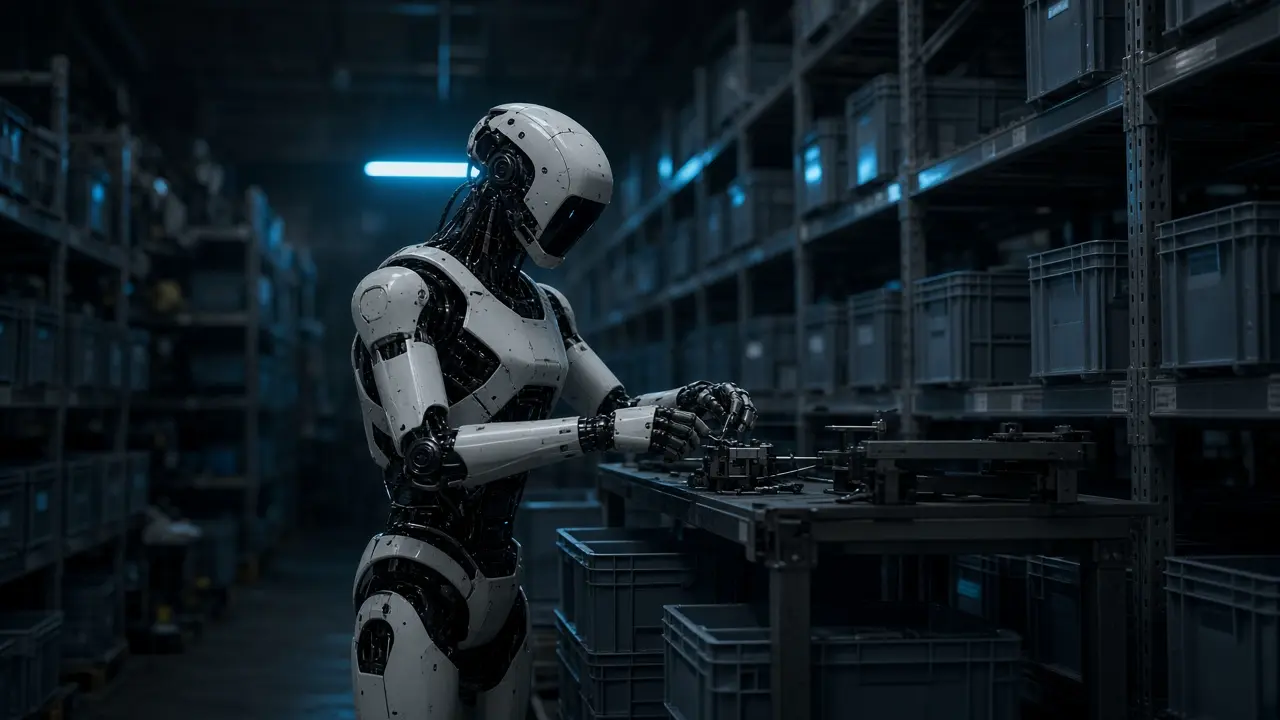
Your Kitchen Robot Is Still a Warehouse Fantasy
Warehouse demos slap. Dinner prep is a different sport. Here's what has to get boring before humanoids go domestic.
The clips keep coming: a bipedal robot folds a towel, opens a fridge, places a cup on a counter. The comments split into two camps — we’re cooked and this is CGI. Both miss the point.
So basically: humanoid robots are becoming useful in structured industrial settings long before they belong in an unstructured home. That gap is not a failure of marketing. It’s physics, perception, and liability.
What “works” actually means
In a warehouse, the world is mostly known. Aisles are fixed. Objects come in SKUs. Cycles repeat. Failures have playbooks. You can instrument the space, constrain the task, and accept that a human supervisor is still in the loop.
In a kitchen, almost nothing is fixed. Lighting changes. Spills happen. Knives exist. A toddler might exist. The cost of a wrong grasp is not a mis-sorted box — it’s a burn, a cut, or a lawsuit.
Demos optimize for possibility. Products optimize for reliability under variance. Those are different curves.
The boring bottlenecks
Three things still have to get dull before domestic humanoids are more than science theater:
- Contact-rich manipulation — Soft objects, deformable packaging, liquids. Hands that don’t crush tomatoes and don’t drop plates.
- Long-horizon planning — “Make breakfast” is not one skill. It’s dozens of subtasks with recovery when the eggs aren’t where you left them.
- Cost and service — A $20k–$50k appliance that needs a field tech for every jammed drawer is not a consumer product. It’s a science project with a subscription.
Battery life and walking get the headlines. Manipulation and recovery get the product.
What to watch instead of the hype reel
Ignore the sock-folding video for a minute. Watch for:
- Fleets running multi-shift in real facilities with disclosed uptime
- Task definitions that include failure rates, not just success clips
- Clear statements about teleoperation vs. autonomy in the demo you just watched
Teleop is useful R&D. It is not the same as “the robot decided.” Confusing the two is how the hype machine eats the filter.
The grounded take
Humanoids will show up first where labor is scarce, tasks are repetitive, and the environment can be partially redesigned around the robot. Factories and logistics before living rooms. That’s not pessimism — it’s the order of operations.
When someone ships a kitchen robot that works on a Tuesday night with dirty dishes in the sink and no engineer on call, we’ll cover it. Until then, treat the fridge-opening clip as a progress report, not a product announcement.
So basically — pass it on.