IonQ Just Linked Two Kinds of Qubits 1,000 Times a Second
IonQ says it entangled a trapped ion qubit with a diamond quantum memory more than 1,000 times per second, four times the old record for trapped ions. Fast links like this are how separate quantum computers could one day work as one big machine.
So basically: One quantum computer can only get so big. The plan is to link a bunch of them together, like servers in a data center. That needs a fast connection. On Thursday, Oct. 9, IonQ said it built a link that connects two very different kinds of qubits more than 1,000 times every second. That is four times faster than the old record for this kind of system.
The problem it solves
Regular computers got huge by wiring lots of chips, memory, and networks together. Quantum computers will probably have to grow the same way.
But you cannot just run a cable between two quantum machines. To make them work together, you have to “entangle” them. That is a special quantum connection that lets two separate systems act as one.
The usual way to do that is slow. Each side shoots out a single particle of light, called a photon, and both photons have to be caught at the same moment. Light gets lost along the way all the time. So most tries fail.
What IonQ did
IonQ connected two different things:
- A trapped ion. A single charged barium atom held in place by electric fields. These are great at holding quantum information for a long time.
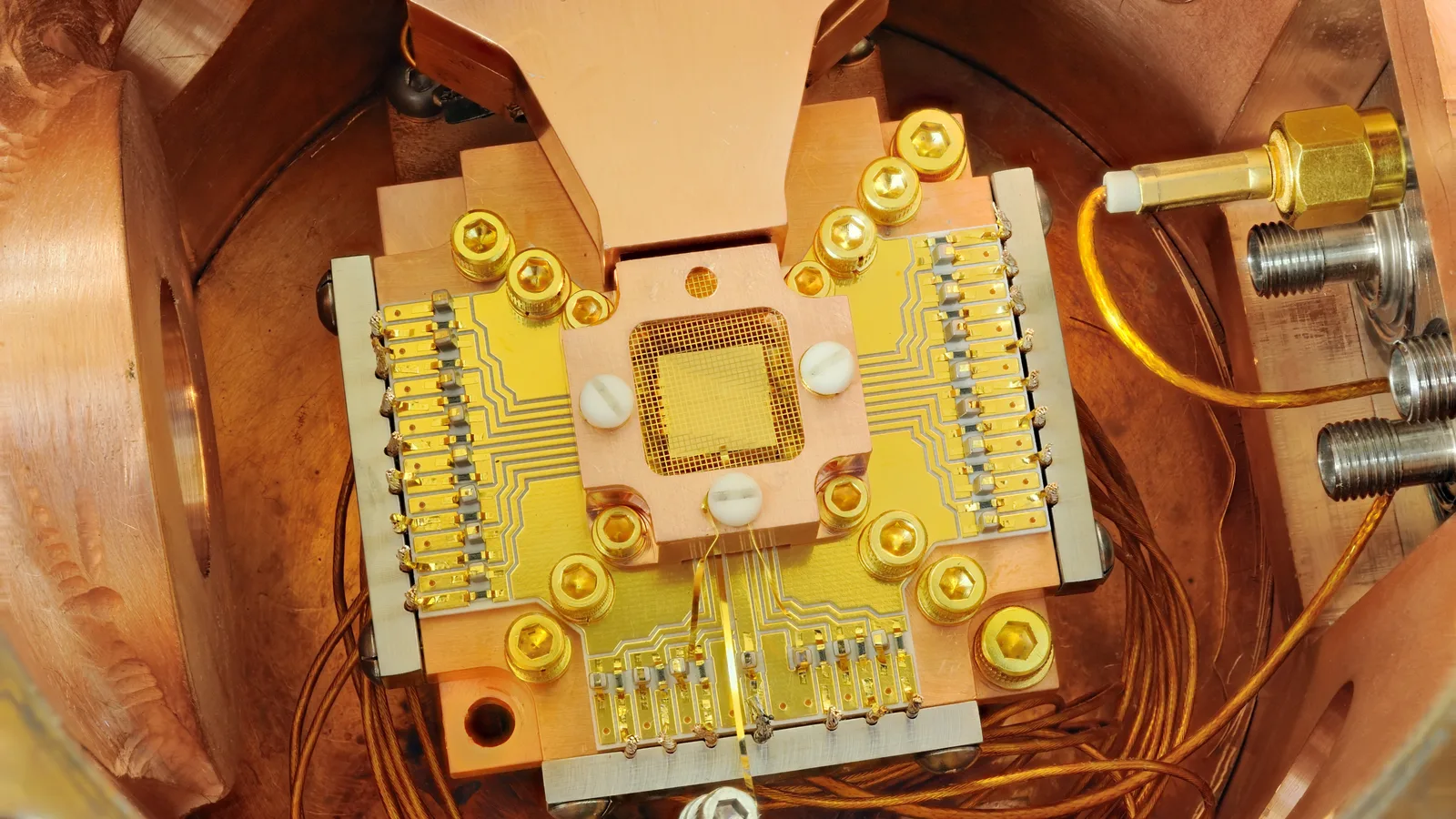
- A diamond memory. A tiny flaw in a diamond, called a silicon vacancy, sitting inside a very small light trap. These are great at grabbing light.
Here is the trick. Instead of needing two photons to show up at once, IonQ only needs one.
- The ion shoots out a photon
- A crystal shifts the photon’s color so the diamond can work with it
- The photon bounces off the diamond memory
- If a detector catches that one returning photon, the two are entangled
Needing one photon instead of two means a lot fewer failed tries.
The numbers
From IonQ and the technical paper, as written up by Quantum Computing Report:
- Speed: 1,032 entangled pairs per second, or about one every millisecond
- Quality: 87.9 percent fidelity, a measure of how clean the connection is
- Old record: about four times slower, set by a Duke University lab run by IonQ cofounder Chris Monroe
- The cold part: the diamond memory sits in a fridge at 20 thousandths of a degree above absolute zero
That one millisecond pace matters. Quantum Computing Report notes it matches the roughly one millisecond cycle time planned for future error corrected trapped ion processors. In plain words, the link is finally fast enough to keep up with the computer.
Why it matters beyond IonQ
IonQ says the diamond side can talk to almost any kind of qubit. That could include neutral atoms, and superconducting chips like the ones Google and IBM use, with an added converter.
This is part of a DARPA program called HARQ, which wants high speed links that work across different qubit types.
IonQ also worked with diamond maker Element Six and Amazon Web Services on a way to make these diamond memory chips in a factory, not just in a university clean room.
And it is already selling the memory hardware. The University of Maryland bought the first system in April. A company called SDT in South Korea bought one in September.
The honest caveat
This is one link between two nodes in a lab. It is not a network of quantum computers yet, and it is not running real distributed programs yet.
87.9 percent is good for this kind of link, but it is not perfect. Real systems will need that number to keep climbing.
My take
This is the kind of quantum news I actually care about.
Not “we built a chip with more qubits.” Instead, “we solved the plumbing.” Every big computing jump has been about connecting things, not just making one thing bigger.
If you can link quantum machines fast enough, you do not need one giant impossible machine. You need a lot of normal sized ones talking to each other.
IonQ just made that talking about four times faster.
So basically — pass it on.