ITER Just Got the Last Big Piece of Its Fusion Machine
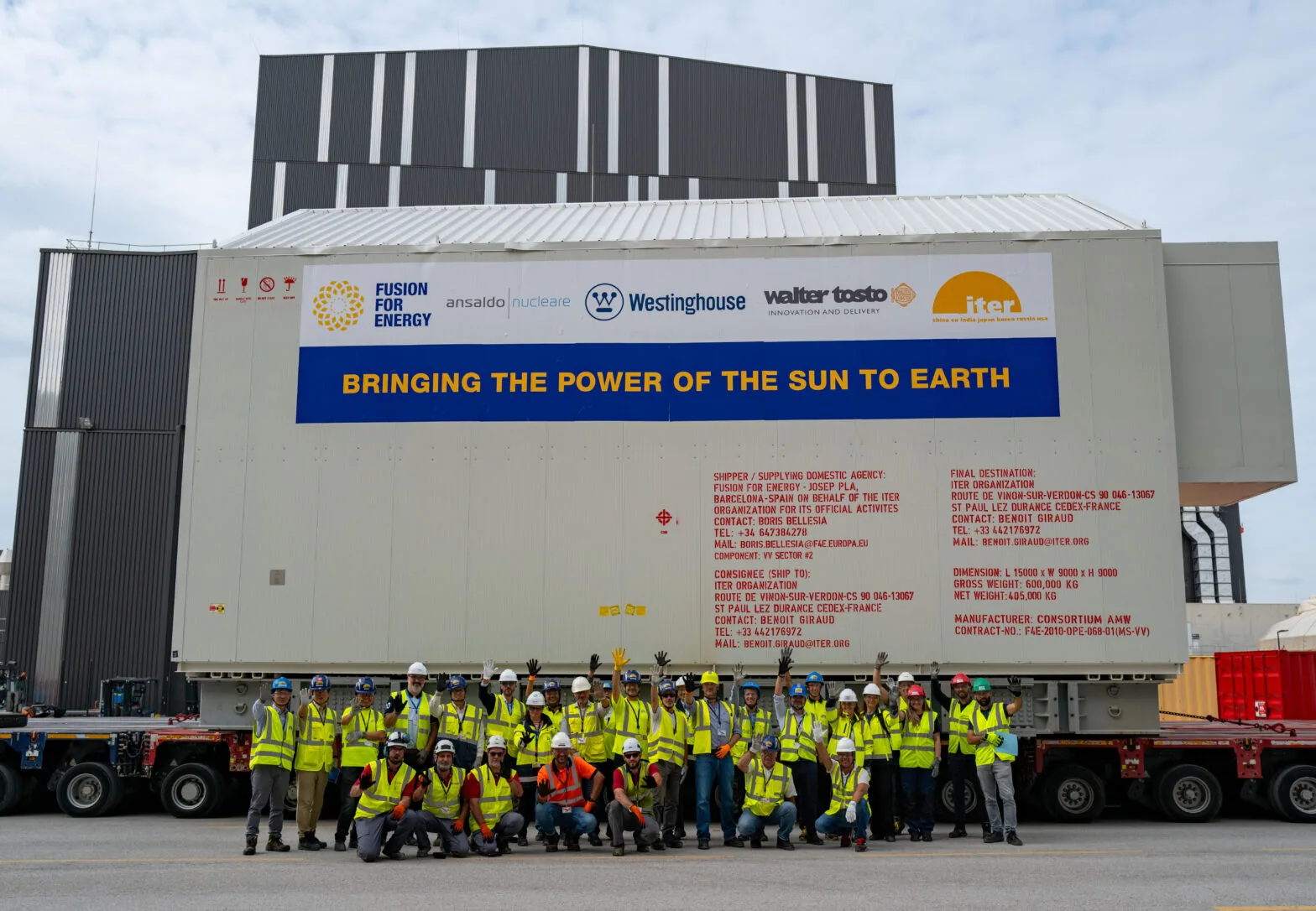
Europe's fifth and final vacuum vessel sector reached the ITER site in France on Oct. 2. ITER says every core component of the machine is now on site. Research operations are still set to start in 2034.
So basically: The last big part of ITER, the giant fusion experiment being built in southern France, arrived on site Friday, Oct. 2, so every core piece of the machine is finally there.
What arrived
It’s vacuum vessel sector #2. That is the ninth and final slice of the steel chamber where the fusion plasma will sit.
ITER staff and contractors held a short ceremony on the worksite Monday, Oct. 5. Director-General Pietro Barabaschi stood in front of the still-wrapped part and called it “a monument.”
Fusion for Energy, the EU agency that runs Europe’s share of ITER, says it is officially the last large ITER component delivered on site.
The sector left Westinghouse’s factory in Monfalcone, Italy, on Sept. 15. It went by sea to the port of Fos-sur-Mer near Marseille, then by road to the site at Cadarache.
The vessel in numbers
Nine sectors make one ring. Europe built five. South Korea built four.
Joined up, the vessel will be 19.4 meters across, 11.4 meters tall, and weigh about 5,200 tonnes. Each sector is about 440 tonnes on its own.
It’s double-walled stainless steel. Its job is to keep air and dust out so the plasma stays clean, while huge superconducting magnets around it hold the plasma off the walls.
Europe’s five sectors took more than 2 million work hours and 750 km of weld beads. The work ran through Ansaldo Nucleare, Westinghouse, and Walter Tosto, plus a supply chain of at least 15 companies, over about 16 years. All five European sectors arrived in the last two years. Fusion for Energy says it even used AI to cross-check factory inspection data.
Where the build stands
ITER says that with this delivery, every toroidal field coil, poloidal field coil, correction coil, central solenoid magnet, vacuum vessel sector, and thermal shield set is now on site.
Assembly is moving faster than planned. In July, ITER lowered the sixth of nine sector modules into the tokamak pit, almost six months ahead of schedule. A sector module is one vessel sector packed with thermal shields and two toroidal field coils, about 1,100 tonnes total. ITER now expects the last module in the pit by mid-2027, up from December 2027.
That’s not the finish line. In-vessel parts like the divertor and blanket, plus plant systems, are still to come. Then the nine sectors have to be welded into one ring.
The timeline
ITER reset its plan in 2024. The current baseline:
Cryostat closure in 2033.
Start of Research Operation in 2034.
Full magnetic energy in 2036.
Deuterium-tritium operation in 2039.
That 2039 date is four years later than the old 2016 plan.
ITER is not built to sell power. Its main goal is a burning plasma, where the energy from the fusion reactions is enough to keep the plasma hot on its own. That is the step real fusion power plants need.
Who pays
There are seven members: China, the EU, India, Japan, South Korea, Russia, and the U.S. Europe, as the host, covers almost half the construction cost. The other six split the rest equally.
My take
Getting every core piece on site after decades is a real milestone. The assembly team beating its own schedule is the best ITER news in years. But this is a 2030s machine, and the private fusion race is moving at the same time. Commonwealth Fusion Systems just ordered more than 10,000 km of superconducting tape for its first ARC power plant in Virginia. ITER’s biggest value now is the physics data, the trained workforce, and the supply chain that those private plants will lean on.
So basically — pass it on.