A Gene Therapy Plus Goggles Helped Some Blind Patients Find Objects Again
A study published Oct. 7 in the New England Journal of Medicine treated 10 people blinded by advanced retinitis pigmentosa with an optogenetic gene therapy and special goggles. It was safe, seven became more sensitive to light, and some could find objects and doorways, though none got normal sight back.
So basically: Scientists gave 10 blind people a one-time gene therapy that makes some of their leftover eye cells react to light. Paired with special camera goggles, it was safe, and several patients could find objects, doorways, and lines on the floor again. It did not give anyone normal sight. But it worked in more than one person, which is a big deal.
The disease
The patients all had advanced retinitis pigmentosa, or RP.
RP is an inherited disease. It slowly kills the photoreceptors, the cells in the retina that actually sense light. Over years, people lose their night vision, then their side vision, then most or all of their sight.
More than 100 different genes can cause it. That is a big problem for gene therapy, because most gene therapies fix one specific broken gene. A fix for one type of RP does nothing for the others.
The trick
This approach skips the broken gene entirely.
Behind the dead photoreceptors, the eye has other cells called retinal ganglion cells. They normally pass signals to the brain. They do not sense light on their own. In RP, many of them survive.
So the team gives them a new job.
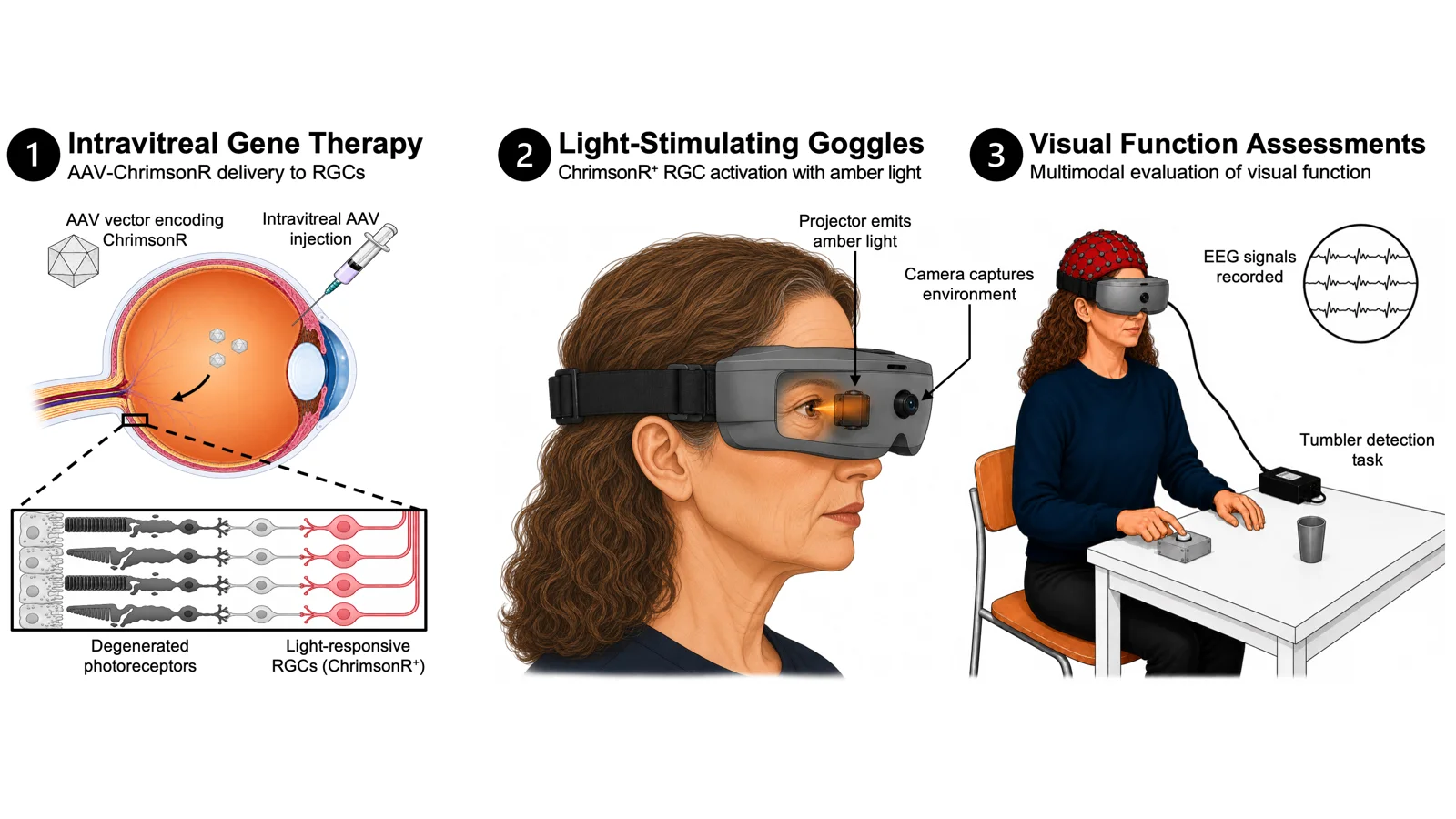
- Each patient got a single injection in their worse eye
- The injection carries instructions for a light-sensitive protein called ChrimsonR
- ChrimsonR comes from algae and responds to amber light
- Now those surviving cells can react to light directly
The catch is that ChrimsonR needs strong amber light. Normal daylight is not enough.
That is where the goggles come in. They have a camera that watches the scene, then project matching pulses of amber light into the treated eye.
Put simply: the gene therapy makes the cells able to see light, and the goggles supply the light.
The results
The study was published Oct. 7 in the New England Journal of Medicine. It was led by José-Alain Sahel at the University of Pittsburgh and Botond Roska at the Institute of Molecular and Clinical Ophthalmology Basel in Switzerland. GenSight Biologics backed the trial.
Here is what they found:
- Safety, the main goal: Within the limits of the study, it was safe. Most eye side effects were mild or moderate. One severe event happened right after an injection and cleared up within minutes.
- Light sensitivity: Seven of 10 patients became more sensitive to light. Six improved enough to count as clinically meaningful.
- Real tasks: Four of the eight patients who finished the vision tests got better at detecting or locating objects. Even more improved at finding a doorway or following a line while wearing the goggles.
- The brain: Brain scans with EEG showed visual signals reaching the parts of the brain that handle sight.
What it did not do
This is important. Patients still could not read. They still could not recognize faces.
This is not a cure. It is more like turning total darkness into rough shapes and locations.
Practice matters
One finding stood out. Patients who spent more time training with the goggles did better on the object tests.
So this might work less like a pill and more like learning a new skill. Rehab could end up being a big part of the treatment.
Why it is a milestone
Back in 2021, the same team reported one patient who could see and touch objects after this treatment. That made headlines, but it was one person.
Now they have shown it in a group. Stefan Futterknecht, the study’s second author, said it shows the effects “can be reproduced across several patients.”
And since it does not depend on which gene caused the blindness, it could someday help a lot more people with RP.
My take
I find this one genuinely moving. These patients had almost no vision left, and some of them can now walk to a doorway.
But I want to be careful. Ten patients is tiny. The goggles are bulky. And “find an object on a table” is a long way from driving or reading.
The next step is more sensitive versions that need less light and work better. If that happens, this goes from lab miracle to something a lot of people could actually use.
So basically — pass it on.