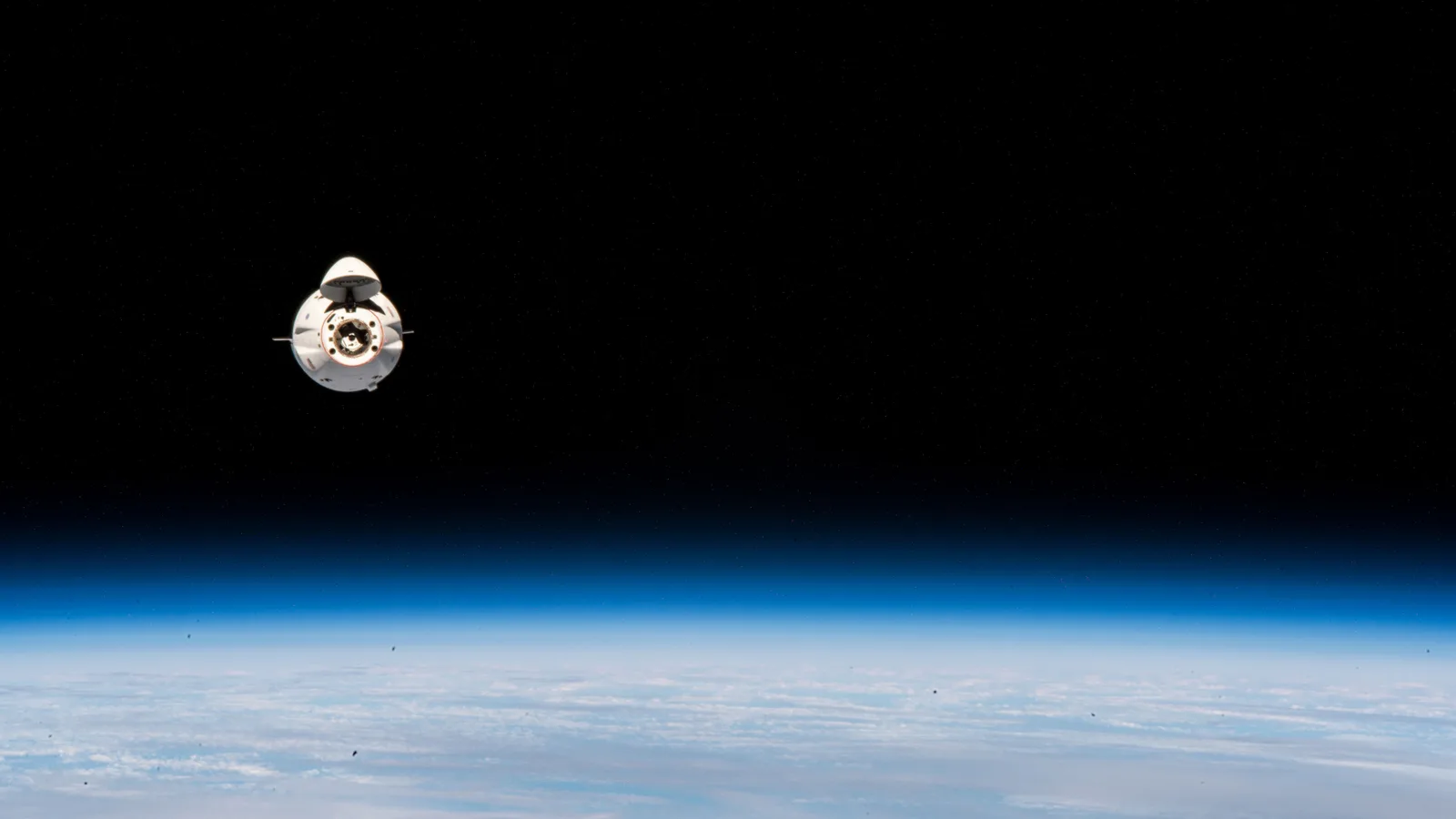
SpaceX's Next Cargo Dragon Launches Tuesday With Artificial Retinas and Mini Brains
NASA and SpaceX are targeting 6:33 a.m. ET Tuesday, Oct. 13, for CRS-35. Dragon carries more than 6,300 pounds to the space station, including the last pair of new solar arrays and experiments that build artificial retinas, heart tissue, and brain organoids in orbit.
So basically: SpaceX is sending another cargo Dragon to the International Space Station on Tuesday morning. It is carrying more than 6,300 pounds of supplies, gear, and science. The big items are the station’s last pair of new solar arrays and a set of experiments that try to build artificial retinas, heart tissue, and mini brains in space.
When and where
- Launch: 6:33 a.m. ET, Tuesday, Oct. 13
- Rocket: Falcon 9 from Space Launch Complex 40 at Cape Canaveral
- Docking: around 11 a.m. ET, Thursday, Oct. 15, at the space-facing port of the Harmony module
- Coverage: NASA’s stream starts at 6:15 a.m. ET
This is CRS-35, the 35th SpaceX resupply run for NASA. Spaceflight Now says the capsule is Dragon C211 on its fourth flight, and the booster, B1096, is flying for the eighth time.
Dragon docks by itself. NASA astronaut Anil Menon and Canadian astronaut Joshua Kutryk will keep an eye on the arrival.
The science on board
This is the fun part. Four experiments stand out.
Artificial retinas. LambdaVision-1 builds artificial retinas one thin layer at a time. On Earth, gravity makes the material settle unevenly. In orbit, the layers may come out smoother and more stable. The goal is an implant that could help restore sight for people with retinal diseases that have no cure today.
Heart tissue. Stellar Spheroids grows small 3D models of human heart tissue. Researchers want to see if microgravity helps them form better blood vessel networks. More realistic heart models mean better drug testing.
Mini brains. MINDS studies brain organoids, which are tiny lab grown clumps of brain cells. It uses “organoid villages” that mix cells from several people, so the results better reflect real patients. The focus is inflammation tied to Alzheimer’s, Parkinson’s, and multiple sclerosis.
Weird glass. ELF-Unconventional Glass 2 melts glass made from unusual elements and watches how it forms without gravity. The samples come home for testing. Stronger, clearer glass could end up in future spacecraft and habitats.
The hardware
The biggest piece of cargo is the final pair of Roll-Out Solar Arrays, called IROSAs. These are the roll-up panels NASA has been adding to the station since 2021. This pair finishes that power upgrade. NASA says the extra power supports critical operations, including the station’s safe and controlled deorbit at the end of its life.
There is also some Moon prep. Dragon carries a test unit of a collapsible urinal for Artemis III. Not glamorous, but somebody has to figure it out before astronauts spend days on the lunar surface.
Dragon also flies up an empty foam clamshell. Its job is to bring home a Canadarm2 joint that failed and was swapped out on a June 30 spacewalk, so engineers can study what went wrong.
The trip home
Dragon stays about a month. In mid-November it splashes down in the Pacific off California with finished science and worn out hardware. That includes the arm joint, a spacesuit headed for refurbishment, and parts from the station’s urine and water recycling systems.
That return trip matters. A lot of space science only pays off once the samples are back in a lab on Earth.
Why it matters
Resupply missions do not get the hype of a crew launch or a Starship test. But this is what keeps the station running, and the station is where a lot of space medicine gets tried first.
Making retinas or tissue in orbit is still early. If it works, it is one of the first real reasons to build things in space instead of just studying them there.
My take
I love these “boring” cargo flights. Tuesday’s launch is basically a delivery truck, but the boxes inside are wild. Artificial retinas, mini brains, and heart tissue, all riding up on a reused rocket.
The solar arrays are the part I would watch most. Finishing that upgrade is a sign NASA is planning how the station winds down, not just how it keeps going.
If the retina experiment pans out, that is a story I want to follow. Fixing someone’s eyesight with something made in orbit would be a real future moment.
So basically — pass it on.