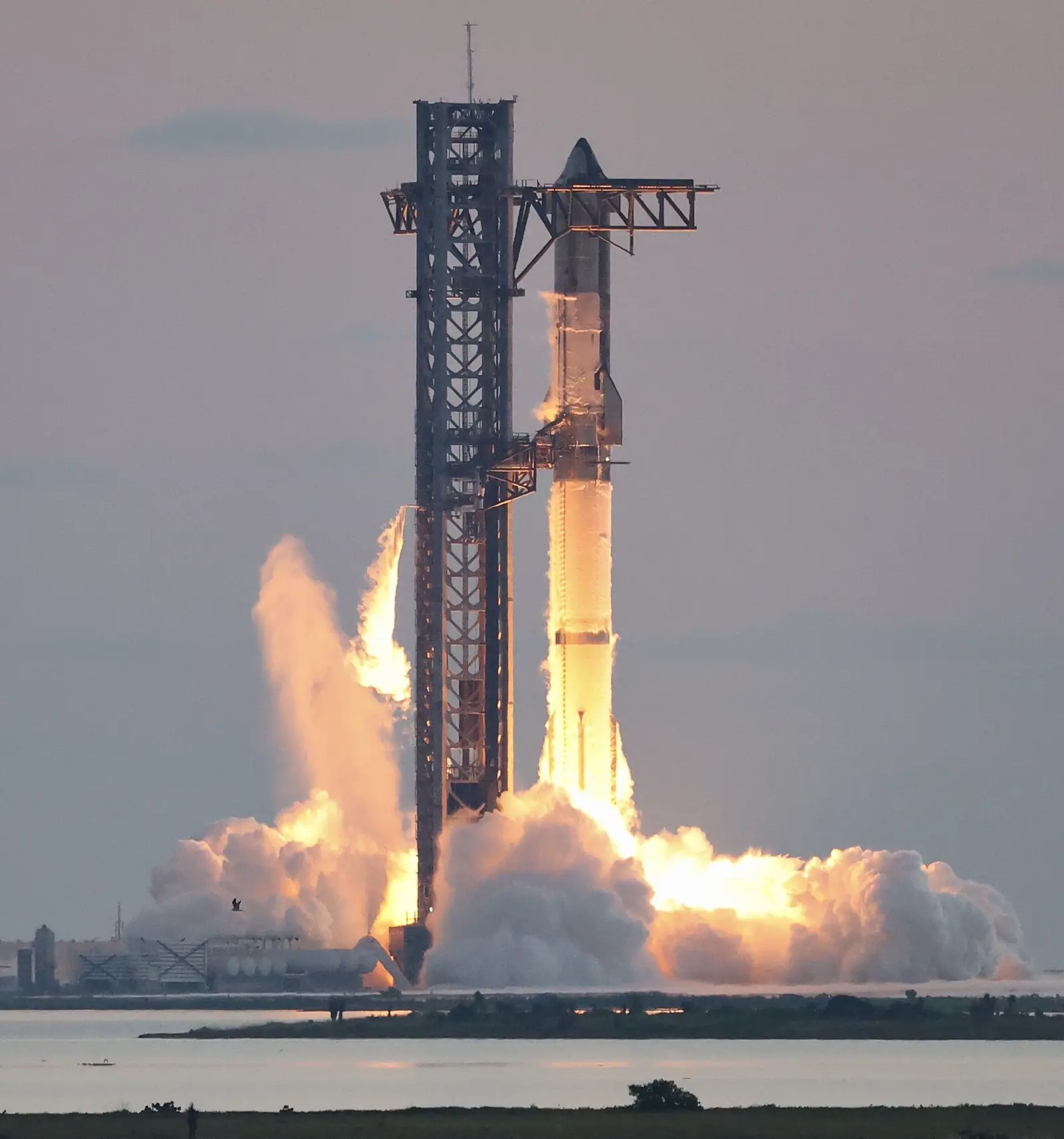
26 Starlinks Ride Starship's First Orbit Attempt
SpaceX is aiming Starship at Earth orbit for the first time — ~275 km, ~6 orbits, 26 Starlink V3 — with the FAA license still the gate and the window now sliding toward Sept. 28.
Thirteen Starship flights taught SpaceX a lot about fire, steel, and coming home the hard way. None of them stayed up.
So basically: Flight 14 is the first time SpaceX is trying to put Starship into orbit — and hang a real revenue payload on it — instead of another carefully short suborbital hop. The company first aimed for Sept. 22; on Sept. 17 it said the new target is as early as Monday, Sept. 28, still pending regulatory approval.
What “going to orbit” actually means here
SpaceX’s own mission page is unusually concrete. Prior tests flew passively safe suborbital trajectories. Flight 14 is planned as the first orbital insertion: Ship at roughly 275 km, about six orbits, roughly 10 hours aloft, then a deorbit burn and Pacific splashdown west of Chile.
The booster’s job is more familiar — ascent, separation, boostback, offshore landing burn in the Gulf. No tower catch on this one. The new homework sits on the ship: insertion only after the flight control team is confident it can still deorbit; then deploy; then come home on purpose.
The payload that makes this feel like a product flight
This is also the first planned drop of 26 Starlink V3 satellites. SpaceX says each V3 adds about 1 Tbps of constellation capacity — roughly 26 Tbps on this mission alone, framed as ~10× a Falcon 9 load of V2 Mini birds. Three of the sats carry cameras to photograph Ship’s heat shield after deploy. That’s not a press-kit flourish; heat shield life is the reuse bottleneck.
If it works, Starship stops being only a flying test article and starts looking like the truck that feeds next-gen Starlink.
The gate that isn’t on the pad
SpaceX keeps putting the same three words next to every date: pending regulatory approval. The FAA license is still the real countdown clock. A six-day slip with no public technical explanation is a reminder that paperwork and range safety can move a megarocket as surely as a sticky Raptor.
The human filter
Suborbital flights answer: does the stack survive the violent parts? Orbit answers: can you insert, operate, deploy, and leave on a timeline that looks like a launch provider? One is a spectacular lab. The other is the start of a business that can fly several times a week — which is the whole point of retiring the old playbook later.
Watch the window, the license, and whether those 26 V3s actually leave the ship. Fireworks are optional. Orbit is the homework.
So basically — pass it on.