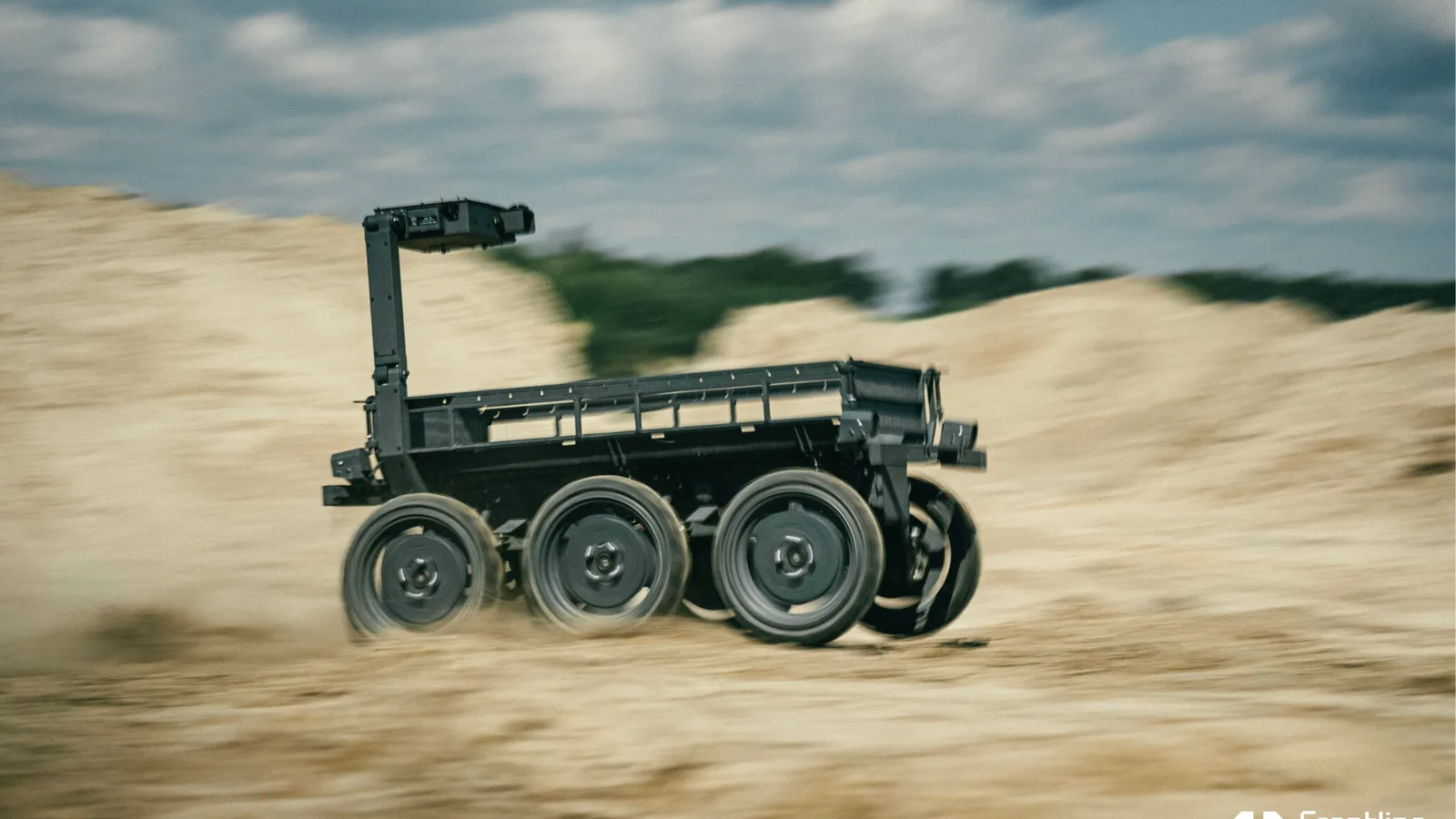
Ukraine's New Frodo Ground Robot Just Carried a Wounded Soldier Out of the Kill Zone
A week after it was unveiled, Frontline Robotics' six-wheeled Frodo made its first real rescue: a 92nd Assault Brigade crew used it to carry a wounded soldier to an evacuation vehicle. Ukraine logged about 112,000 ground robot missions from January to August.
So basically: A Ukrainian ground robot called Frodo just finished its first real rescue. Soldiers from Ukraine’s 92nd Assault Brigade used it to carry a wounded comrade out to an evacuation vehicle. The robot was only unveiled on Sept. 30, about a week earlier.
What happened
The maker, a Ukrainian company called Frontline Robotics, shared the news on Oct. 7. Ukrainian defense outlets Militarnyi, Oboronka, and Defender Media all reported it.
The mission was run by the brigade’s unmanned ground systems company. That is the unit that drives robots instead of trucks.
They used one of the very first Frodo units sent to the military for testing. The robot carried the wounded soldier to a waiting evacuation vehicle.
The operator, who goes by the callsign “Tango,” said the run went faster than usual.
The head of the unit’s workshop, callsign “Viter,” was more mixed. He told Defender Media they ran into some problems on the mission, and that Frontline Robotics has since fixed them.
What he loved was the suspension.
”It helps smooth out the flaws in the road surface. During evacuation it is much softer, much more comfortable for a person to ride,” he told Oboronka.
That matters. The passenger here is someone who is already hurt.
What Frodo is
Frodo is a remote-controlled, six-wheeled robot. Each wheel has its own suspension that adjusts to the ground.
Specs from Frontline Robotics:
- Top speed of 40 km/h, about 25 mph
- Normal payload of 200 kg, max of 400 kg
- Range of up to 150 km on pavement, or about 90 km on rough ground with a normal load
- Ground clearance that adjusts from 170 to 330 mm
- Batteries one person can swap in about two minutes
The company says it can keep going even if it loses a wheel. It also supports several communication links, so it has a backup if one connection drops.
Frodo is not just an ambulance. It has passed Ukraine’s Defense Ministry codification, which is the approval step for military gear. Militarnyi says it can carry weapon modules like the Burya remote turret. Defender Media says it can mount an automatic grenade launcher or a heavy machine gun.
Why robots are doing this job
The front line in Ukraine is now covered by drones. Euromaidan Press describes a “kill zone” tens of kilometers deep on both sides, where almost anything that moves can get spotted and hit.
Sending a truck and a medic into that zone puts more people at risk. Sending a robot puts a machine at risk.
That is why ground robots have exploded there. Ukraine’s Defense Ministry recorded about 112,000 logistics and evacuation missions by ground robots from January through August 2026, according to Euromaidan Press.
That number covers supply runs and evacuations together. An evacuation is the harder job, because the cargo is a person.
This is also not the 92nd Brigade’s first robot rescue. Militarnyi reported in September 2025 that the brigade used a ground robot to evacuate three wounded soldiers.
Why it matters outside Ukraine
Most robot news is about factories, warehouses, and homes. Ukraine is the one place where ground robots are getting used thousands of times a month in the worst conditions possible.
Things like suspension that does not shake a patient, two-minute battery swaps, and backup radio links are getting tested for real there. That feedback loop is moving fast. Frodo went from public debut to a real rescue in a week, and the maker patched problems from that first mission right away.
My take
This is the clearest case of a robot doing a job nobody should have to do.
Frodo is not a humanoid, and it is not autonomous. It is a person with a controller driving a tough, fast cart. That is fine. The win is simple: a wounded soldier got out, and nobody else had to walk into the kill zone to get him.
The thing to watch is volume. One rescue is a headline. If Frodo turns into hundreds of evacuations, that is a real product, and a preview of where search and rescue robots go next.
So basically — pass it on.