Upscale's Token Fabric Wants to Wire Up Any AI Chip, Not Just Nvidia's
Upscale, a $2 billion networking startup, launched Token Fabric on Oct. 8: its own 115.2 Tbps scale-up switch chip, Nvidia Spectrum-X systems for scale-out, and one software layer over both. First pieces ship in Q4, with general availability in early 2027.
So basically: A startup called Upscale just launched Token Fabric, a full networking package for AI data centers. The pitch is that it can connect any AI chip, from any maker, using open standards. It includes Upscale’s own switch chip, and the first parts ship later this year.
The problem it’s trying to solve
A big AI data center is not one giant computer. It is thousands of chips that have to talk to each other constantly.
If the network is slow, those very expensive chips sit around waiting for data. That is wasted money.
There are two kinds of networking here.
Scale-up links chips tightly inside one rack or pod, so they act almost like one big chip. Nvidia does this with its own NVLink technology.
Scale-out links those racks together across the whole building.
Nvidia sells gear for both. But NVLink is built around Nvidia’s own chips. Companies that want to mix in chips from AMD, startups, or their own custom designs need something more open.
What Upscale announced
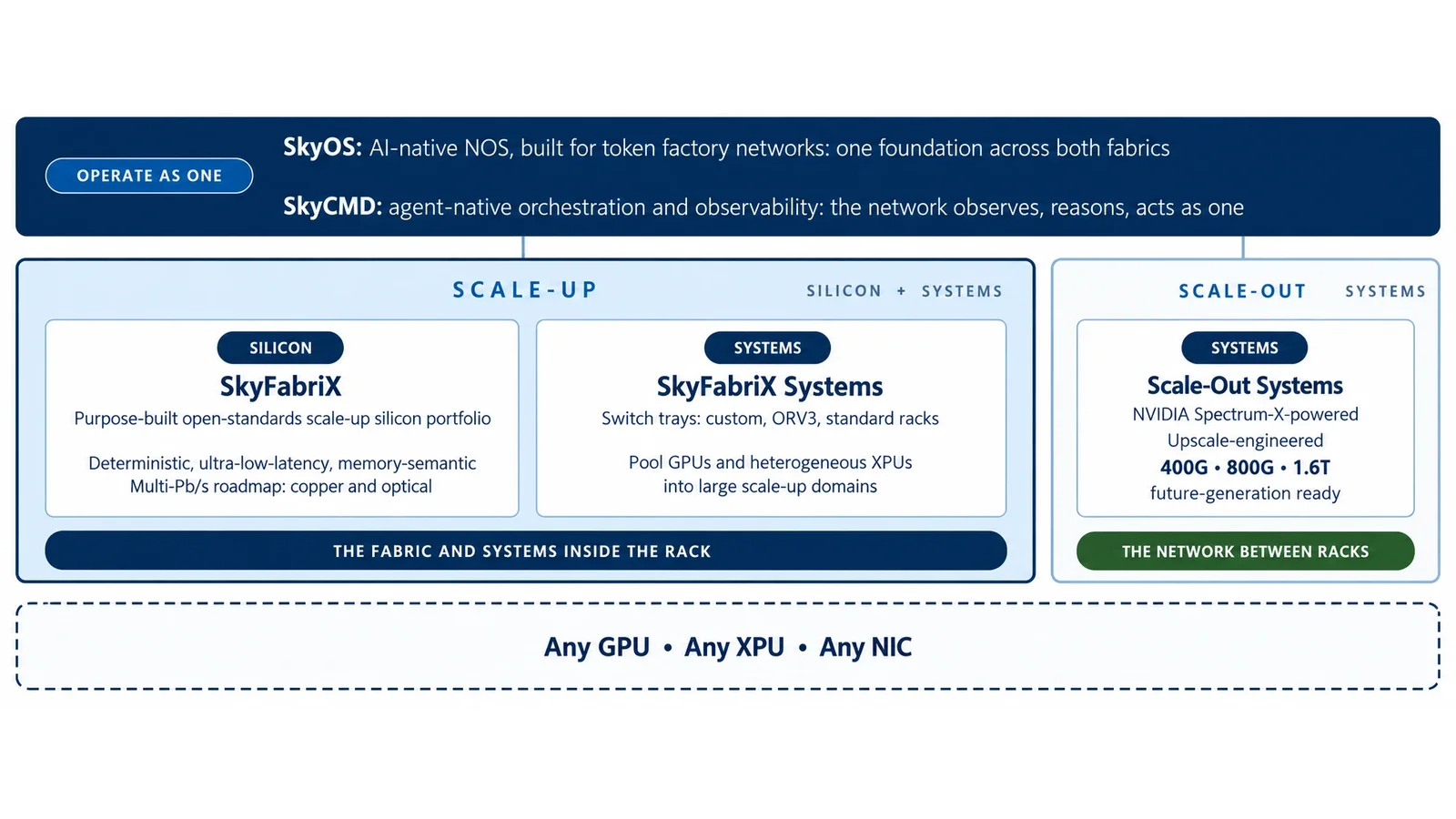
Token Fabric has three layers.
SkyFabriX is Upscale’s own scale-up switch chip. It moves 115.2 terabits per second. Upscale says the roadmap goes to multiple petabits per second, with copper and optical versions.
It supports a list of open standards, including ESUN, UALoE, SUE-T, and regular Ethernet. It is also built to support UALink as that standard evolves. Those are all efforts to give the industry a shared alternative to NVLink.
Scale-out systems are built on Nvidia’s Spectrum-X Ethernet chips. They run at 400G, 800G, and 1.6T. So Upscale is not trying to replace Nvidia everywhere. It is partnering with Nvidia for the building-wide network.
Software ties it all together. SkyOS is the network operating system. SkyCMD is the control layer that watches the whole network and flags problems.
The slogan is “Any GPU, any XPU, any NIC.” XPU is a catch-all word for AI chips that are not GPUs.
Buy it your way
Customers can buy the whole stack, buy systems and add software if they want, or buy just the silicon and run their own software on top.
That last option is aimed at the biggest cloud companies, which like to design their own gear.
When it ships
Reuters reports the first part, the piece that links groups of chips across a data center, ships in the fourth quarter. The full platform rolls out in stages through 2027.
Upscale’s own release says general availability is planned for early 2027. Early access and joint testing programs are running now.
The company will show it at the OCP Global Summit in San Jose, Oct. 12 to 15.
Who is behind it
Upscale was valued at $2 billion in June. That came after a $190 million extension to its early funding round, bringing total funding to $500 million. Backers include Nvidia, Salesforce, and Singapore’s Temasek.
CEO Barun Kar told Reuters he expects Token Fabric revenue next year in the tens of millions of dollars, possibly reaching the low hundreds of millions.
In the release, he put the goal this way: “The industry has spent decades connecting computers. AI demands something different: one computer, built at data-center scale.”
Why the market cares
The numbers are huge. Dell’Oro forecasts nearly $1 trillion in spending on AI back-end switches through 2030. 650 Group says AI networking will pass $200 billion by 2030.
Right now, a lot of that money flows to Nvidia. Upscale is betting buyers want a second option, especially for the tight scale-up links inside a rack.
My take
The interesting part is the awkward relationship. Nvidia invested in Upscale and supplies its scale-out chips. But the whole point of SkyFabriX is to wire up chips that compete with Nvidia’s.
I don’t think this hurts Nvidia much soon. Upscale is a young company and its own chip is not generally available until 2027.
But the direction matters. If open standards like ESUN and UALink get real hardware behind them, buyers get more choice. More choice usually means lower prices.
The real test is next year. Watch whether big customers actually deploy it, or just test it.
So basically — pass it on.